Inez went out the screen door faster than she had moved in twenty years.
"Wait," she called. "Honey, wait."
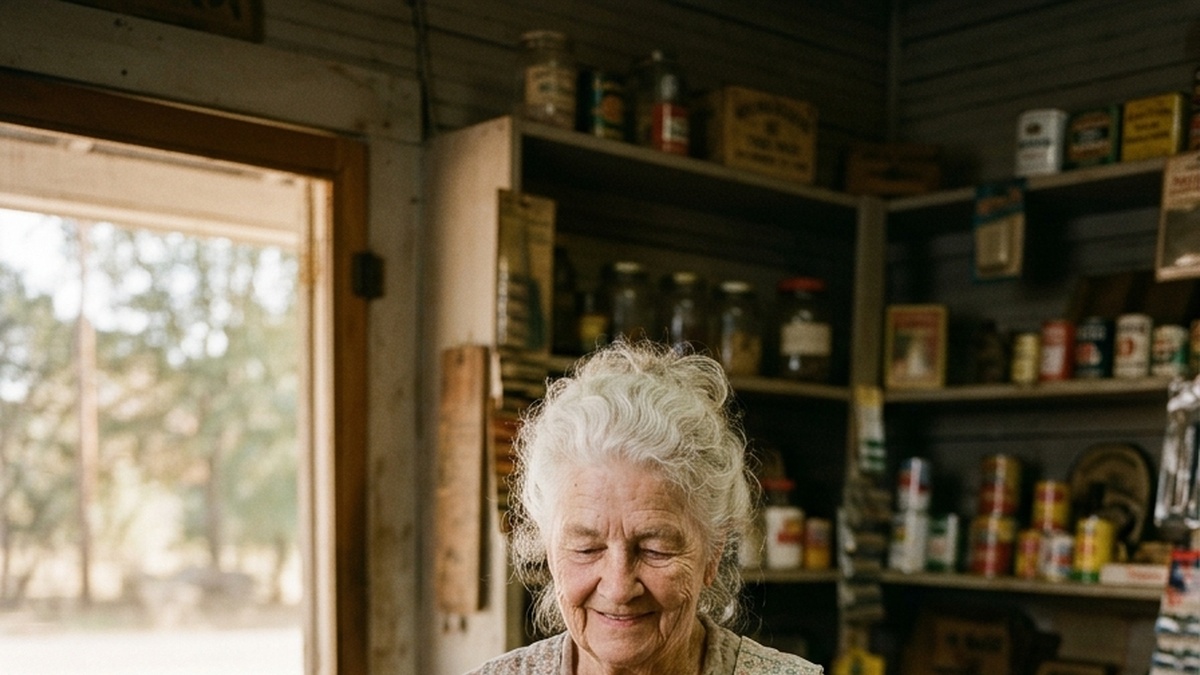
Nora's car was already rolling. Inez stepped right out into the gravel in front of it, in her house slippers, with her apron on, and held up both hands like a crossing guard.
The car stopped a foot from her knees.
Dwight came out on the porch behind her. "Aunt Inez."
Inez did not look at him. She walked around to Nora's open window and put her hand on the door.
"That song," she said. "Sing me the next part."
Nora stared up at her with wet eyes. "What?"
"The next verse. The one after the river. Sing it."
Inez's mother had made that song up herself. She told Inez so, when Inez was small. She said she made it up one summer when she was a girl, to sing to somebody she loved, on the front porch of the store. It had silly words about a catfish who wanted to marry the moon, and a river that carried a letter all the way to the sea.
The first verse, Inez had heard other children sing, because she had taught it to half the town. But the second verse was different. Her mother only ever sang it to Inez, at bedtime, and only in a whisper. Inez had never sung it to anybody, not even her own children. It was the one thing that had belonged only to her mother and her.
Nora looked at her for a long moment. Then she sang it. Very softly, in a cracked, uncertain voice, the way her grandmother must have sung it to her.
Hush now, Lula, the river is wide, I'll keep your half of the moon on my side.
Inez put her hand over her mouth.
All her life, she had thought Lula was only a pretty sound her mother made up, a word to rhyme with nothing.
Behind her on the porch, Dwight had stopped moving.
They sat at the little table in the back of the store with three glasses of sweet tea, and Inez told them both what she had worked out in the time it took to walk across a parking lot.
"Mama always set two plates," she said slowly. "At Thanksgiving, all my life. One extra, at the end of the table. She never said who for. We all thought she was just being Christian, for a stranger."
She looked at the photograph, which Dwight had brought back from the wall and laid on the table between them.
"1931," she said. "That was the worst of it here. The flood had come through in '27 and taken half the farms, and then the Depression took the rest. My grandparents had the store and nothing in it to sell. Mama told me once that there were winters they ate nothing but cornbread and what Granddaddy caught in the river."
Nora was holding her teacup so tight her knuckles were white.
"I think there were two of them," Inez said. "Twins. And I think in 1931 they could only feed one. So Granddaddy sent Lula north to work." She looked down at the photograph. "And when she married up there and didn't come home, I think he never let her name be said in this house again. So she turned into a cousin from Vicksburg."
For a while, the three of them sat without speaking. The ceiling fan turned overhead. Out on the river road, a truck went by.
Then Dwight cleared his throat.
"Miss Lindqvist," he said. "I owe you an apology. I was out of line."
"You were protecting your family," Nora said.
"I was protecting a contract." He looked down at the photograph. "That's not the same thing."
He got up and went to the stockroom and came back with the folder of papers from the company in Jackson. He set it on the table in front of his aunt.
"I'll call them in the morning," he said. "Tell them we need more time."
Inez looked at him a long while. Then she reached over and patted his hand.
"You're a good boy, Dwight," she said. "You just worry too much. Your daddy was the same."
Nora stayed in Bayou Laurel for a week. She slept in the spare room over the store. She and Inez went through every box in the attic together and found three more photographs of two girls who looked exactly alike. In one, they were about six, sitting in a washtub on the porch, laughing.
On Thanksgiving, Inez set the table in the back of the store the way her mother always had. Dwight and his wife came, and Dwight's two boys, and the preacher and his wife, and old Mr. Tolliver from across the road.
At the end of the table, Inez set one extra plate, the way she had every year of her life.
This year, she pulled out the chair beside it and asked Nora to sit there.
After supper, when the dishes were done and the boys had gone out to throw rocks in the river, Inez sat on the front porch in her mother's old rocker with Nora on the step beside her. The sun went down red over the water.
Inez sang the first verse. Nora sang the second. And for the first time since the summer of 1931, both halves of the moon sat on the same front porch.