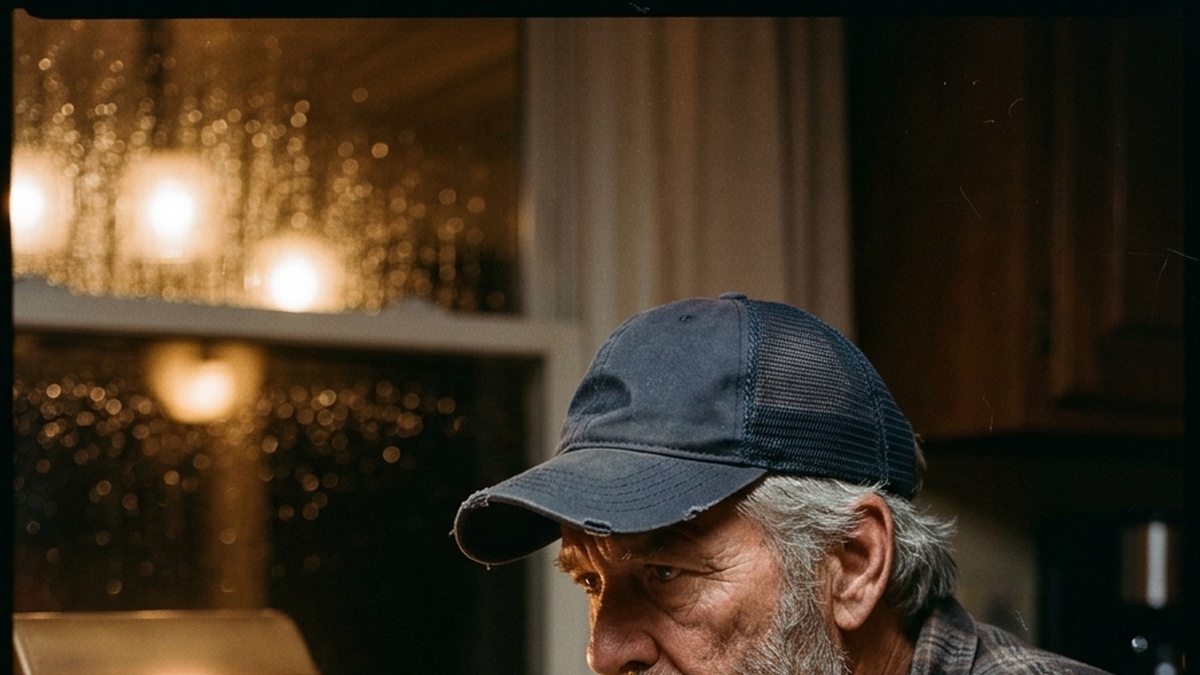
"Caden," Hank said into the microphone. "Caden, come back."
Static.
"Caden, this is Ohio Valley. Come back, buddy."
Nothing.
Lorraine's hand tightened on his shoulder. Hank set the microphone down very gently on the counter, the way you set down something that might break.
"Battery," he said. "That old handheld runs on eight double-A's. He's had it on for twenty-five minutes."
"Hank."
"I know, Lorraine." He was already putting on his coat. "But he gave me what I needed."
He called Earl from the truck with the heater running and the wipers going full speed.
"Earl. The train blew for a crossing at eleven-oh-four. Two longs, a short, and a long. That's the standard horn for a grade crossing. The boy said it was right outside. Real loud."
"There are three crossings in the county," Earl said. "Feed Mill Road, Hollow Creek Road, Lutz Hollow Road."
"Right. And the freight leaves the Marietta yard at ten-thirty, give or take. Takes it about twenty minutes to Feed Mill. Thirty-five to Hollow Creek. Forty-five to Lutz Hollow." Hank pulled out of his driveway onto Maple Street, slow, feeling the tires. "It blew at eleven-oh-four. Thirty-four minutes after half past ten."
There was a pause on the line. Hank could hear Earl thinking.
"Hollow Creek Road," Earl said.
"Hollow Creek Road. With the creek running loud enough to hear in a windstorm. And a big empty barn made of wood so heavy a kid thinks it's logs."
"The Pike barn," Earl said quietly. "He made it to his great-grandma's barn."
"He made it," Hank said. "He just didn't know it."
The Pike farm was four miles out Hollow Creek Road. On a dry night, Hank could have driven it in six minutes. That night, it took him twenty.
He passed two cars in the ditch. He passed the Calder Feed and Seed truck with its flashers on, and Avery Collins and Marco standing beside it in the snow, waving flashlights. Hank rolled down his window and told them where he was going, and they piled into the back of the feed truck and followed him.
Earl's Crown Victoria was already in the Pike lane when they got there, its headlights pointed at the great dark side of the chestnut barn. Earl was standing at the big sliding door with his flashlight, shouting the boy's name.
The barn was huge. Josiah Pike had built it to last two hundred years. In the dark, with the snow blowing through the cracks between the old boards, it looked like a ship.
"Hay's up top," Hank said. "He said he climbed into the hay."
Marco found the ladder. Hank went up it first, because he was the one the boy knew, with Avery holding the light from below. His knees did not like it. He did not care.
The haymow was black and cold, and smelled of dust and old summer. Hank swung the flashlight across the bales.
There. In a nest he had dug between two bales near the west wall, curled up tight under a pile of loose hay, was a small shape in a blue winter coat. One mitten was off. The other hand was still holding a black handheld CB radio with a dead red light.
"Caden," Hank said softly.
The boy did not move.
Hank crossed the haymow on his hands and knees and pulled off his glove and put two fingers against the boy's neck. Cold. But under the cold, a pulse. Slow and steady.
Caden's eyes opened a crack.
"Hank?" he whispered.
"Yeah, buddy. It's Ohio Valley."
"My radio died."
"I know it did," Hank said. "You did good anyway. You told me just enough."
They carried him down the ladder wrapped in Hank's coat. The ambulance from Marietta met them on Hollow Creek Road. The paramedics said his temperature was low but not dangerous, and that crawling into the hay was the smartest thing he could have done.
Earl called the boy's father from the side of the road. Hank stood in the snow nearby and did not mean to listen, but he heard Earl say, "He's okay. He's okay. He walked to your grandmother's barn." And then, after a long time, "No. I think you two should talk to her about that. All of you. Together."
They did talk. On a Sunday afternoon after Christmas, in the dayroom at Maple Grove.
Hank heard about it later from Dot, who had heard it from the Maple Grove cook. Ada Pike had sat in her wheelchair with her great-grandson on one side and her grandchildren on the other and listened to all of them argue for a while. Then she had raised one hand.
"Caden walked eleven miles in a snowstorm to tell me not to sell the barn," she said. "Not one of you ever asked me what I wanted. He did."
The farm would stay in the family. The fields would be leased to the Yoder boys to pay for Ada's care. And when Caden was old enough, the barn was his.
In January, a package arrived at the house on Maple Street. Inside was the old black handheld CB, with eight new double-A batteries taped to the back, and a note in an eleven-year-old's handwriting.
Dear Hank. My dad says I can keep my grandpa's radio if I learn how to use it right. Will you teach me? My handle is going to be Chestnut.
Hank showed it to Lorraine. She read it twice and handed it back to him without a word.
That night, he sat at the kitchen counter with his coffee and turned the old Cobra to channel 19.
"Breaker one-nine," he said. "This is Ohio Valley, looking for Chestnut. You got your ears on, buddy?"
There was static for a long moment. Then a small voice, clear and steady this time.
"This is Chestnut. I hear you, Ohio Valley. Loud and clear."